Faroes by Boat
 Sørvágur
→
Bøur
→
Sørvágur
→
Bøur
→
 Gásadalur
→
Gásadalur
→
 Tórshavn
→
Kirkjubøur
→
Tórshavn
→
Kirkjubøur
→
 Nólsoy
→…
Nólsoy
→…
What you’ll remember
8 of them Day 2
Step off a moving boat onto the quay
Day 2
Step off a moving boat onto the quay
 Day 2
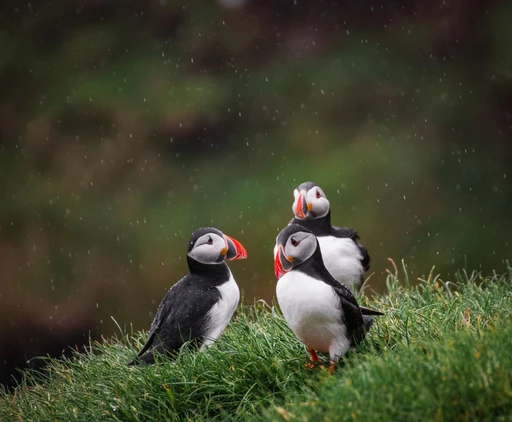
Sit in the grass while puffins land an arm's length away
Day 2
Sit in the grass while puffins land an arm's length away
 Day 3
Stand where a lake hangs above the ocean
Day 3
Stand where a lake hangs above the ocean
 Day 3
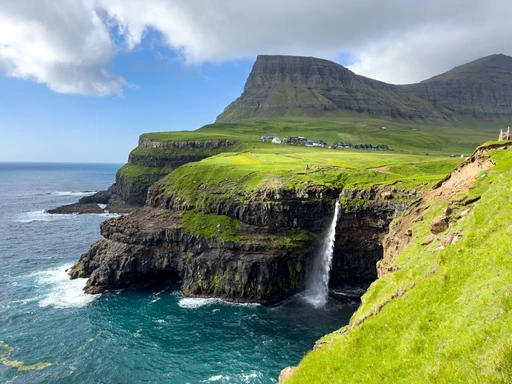
Watch a waterfall land in the ocean
Day 3
Watch a waterfall land in the ocean
 Day 4
Eat dinner in a log house one family has lived in for seventeen generations
Day 4
Eat dinner in a log house one family has lived in for seventeen generations
 Day 5
Spin wool straight off the sheep into thread
Day 5
Spin wool straight off the sheep into thread
 Day 6
Drive through the only roundabout in the world built under the sea
Day 6
Drive through the only roundabout in the world built under the sea
 Day 6
Walk out to a lighthouse on a ridge that drops away on both sides
Day 6
Walk out to a lighthouse on a ridge that drops away on both sides
What’s included
- Hotels every night
- Breakfast every morning
- A packed lunch on the island days
- Welcome dinner in Sørvágur
- Dinner
- All transport during the trip
- A walk through the villages
- All entry tickets
- Farewell heimablídni, dinner in a Faroese family's home
- Seabird colony
- Wool workshop
About this trip
Seven days around a country of eighteen islands and 55,000 people, where three of the best days start by getting on a boat. You land on a runway the British cut into a valley in 1942 because it cannot be seen from the sea. You cross open water to an island of fifteen people and a great many more puffins, eat dinner in a log house the same family has lived in for seventeen generations, and walk out to a lighthouse on a headland that falls away on both sides. Puffins in the grass, grass on the roofs, and a wind that has opinions. Summer only, because that is when the boats run and it barely gets dark.
Day by day
7 daysSørvágur
 Sørvágur
 Bøur
Bøur

You land at the only airport in the country, on a runway British Royal Engineers cut in 1942 because this particular valley cannot be seen from the sea, and therefore not from a German warship either. The first airplane came down here in the autumn of that year. Then it sat abandoned for eighteen years until two men from Sørvágur decided it should be an airport again, and in 1963 it was.
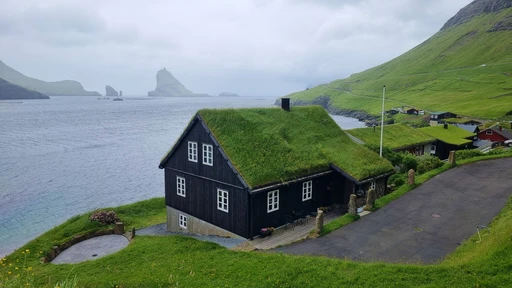
Your coordinator meets the group and it is a five-minute drive to Sørvágur, 1,167 people along a long thin bay, and the pier you leave from in the morning. In the afternoon, out to Bøur, which has seventy-two residents, black tarred timber, grass on the roofs and a view across the water to the islet of Tindhólmur. Welcome dinner tonight, and an early night, because the boat does not wait for anybody and has never pretended otherwise.


Mykines
Bøur
Sørvágur
 Mykines

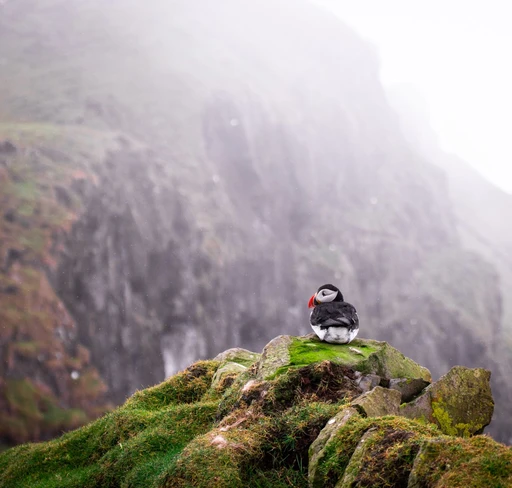
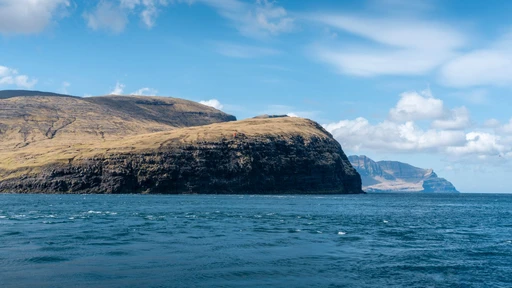
The boat leaves Sørvágur at half past nine and takes forty-five minutes across open Atlantic to the westernmost island in the country. Getting off involves a small step, or a jump, between the boat and the quay, because the boat is moving and the quay is not. Nobody has ever made this look graceful.
Nine people live on Mykines. In summer they are comprehensively outnumbered. An approved local guide takes the group up through the village and out into the outfield, because that is the only way anyone walks here: the island lets in two hundred visitors a day and the grass is open from ten until five. You go north past Grótvalaportrið and out to the viewpoint á Rógvu, birds sitting in burrows a meter from the path most of the way, and the cliffs below loud with them. From the viewpoint you can see the lighthouse standing out on Mykineshólmur, and the footbridge across to it, and you do not go. That path shuts for the whole summer so the puffins can raise their chicks undisturbed. Getting turned back by a bird is a fairly Faroese way to spend an afternoon.
Honest warning, and we would rather say it now than on the pier. This is open water and the crossing is the first thing the weather cancels. If it does, the coordinator moves the island to a later day and today becomes the lake and Gásadalur instead. You lose nothing except the running order.


Sørvágur → Tórshavn
Mykines
Sørvágur
 Sørvágsvatn
 Trælanípa
 Bøsdalafossur
Gásadalur
Bøsdalafossur
Gásadalur
 Tórshavn


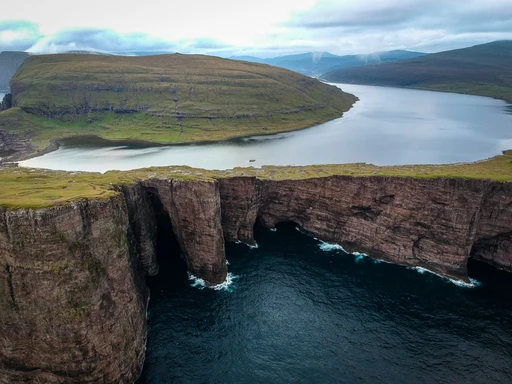
The biggest lake in the country sits thirty-two meters above the sea, held up by a cliff, and it empties over the edge in a waterfall called Bøsdalafossur. You walk in along the shore for about an hour and a half on a rising but even path, and at the far end the ground drops away at Trælanípa and the lake appears to hang in the air above the ocean. It is an optical illusion and it works on absolutely everyone.
Nobody can agree what the lake is called, incidentally. Sørvágur says Sørvágsvatn, Miðvágur says Leitisvatn, and most people just say Vatnið, the lake, and change the subject.
Then across to Gásadalur, fifteen people in a bowl of mountains, where Múlafossur drops off the cliff edge straight into the sea. Until 2004 there was no road here at all, only a path over a mountain more than four hundred meters high, which is the way the mail came. Afterward, the subsea tunnel across to Streymoy and forty-six kilometers east to Tórshavn, where you are based for the rest of the week.


Kirkjubøur
Tórshavn
 Kirkjubøur

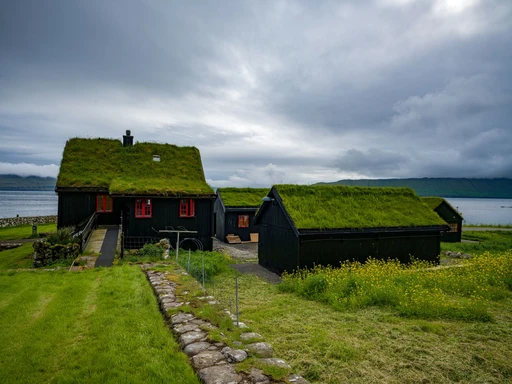
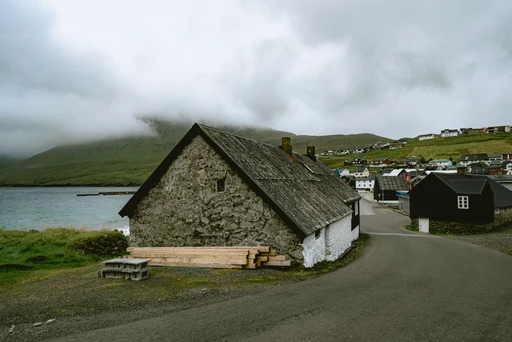
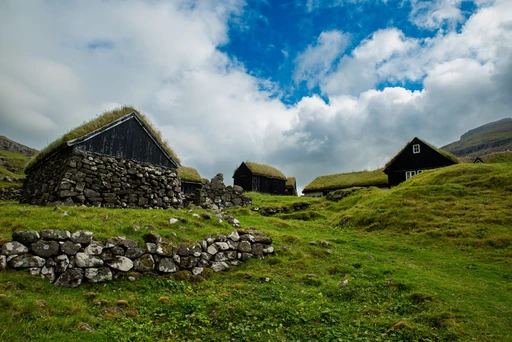
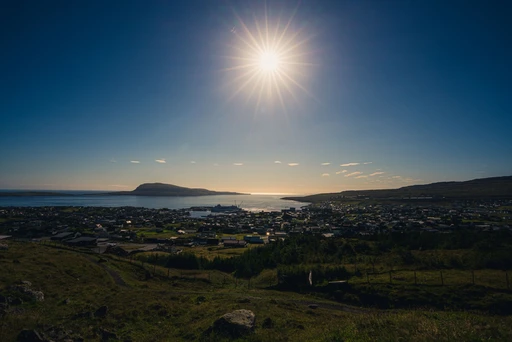
Fourteen thousand four hundred people, which makes Tórshavn the biggest town in the country by a factor of nearly three, and it still takes about twenty minutes to walk across. Start at Tinganes, the rock between the two harbors where Vikings met to make law around the year 900 and where the government still works today, in small red timber houses with grass growing on the roofs and nobody at all guarding the door.
In the afternoon, south over the ridge to Kirkjubøur, seventy-nine people and eight hundred years of having been the most important village in the Faroes. The wall of St Magnus Cathedral is the largest medieval building in the islands, begun around 1300 by a bishop called Erlendur, and there is a saint's relic sealed in a lead casket inside the altar wall that nobody has ever taken out. Next to it is the oldest church in the country still holding services.
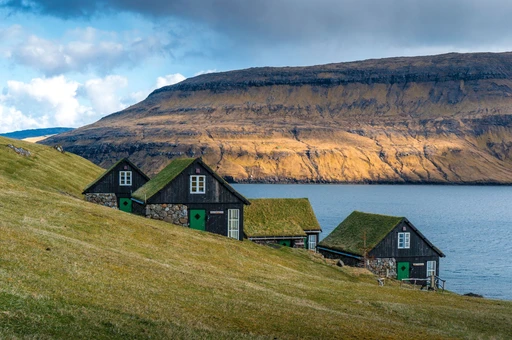
Then dinner in the roykstovan, the log room at the heart of Kirkjubøargarður, which is more than nine hundred years old and has been one family's home for seventeen generations. You eat at a table in a room with a hearth and a hole in the roof ridge for the smoke to leave by. Try to think of anywhere you have eaten that beats it.
Nólsoy
Kirkjubøur
Tórshavn
 Nólsoy


Thirty minutes on the ferry from the harbor you have walked past all week and you are on an island of 220 people with one village, one grocer and no reason whatsoever to hurry. Walk the heritage path north of the houses, two kilometers and an hour if you keep stopping, which you will.
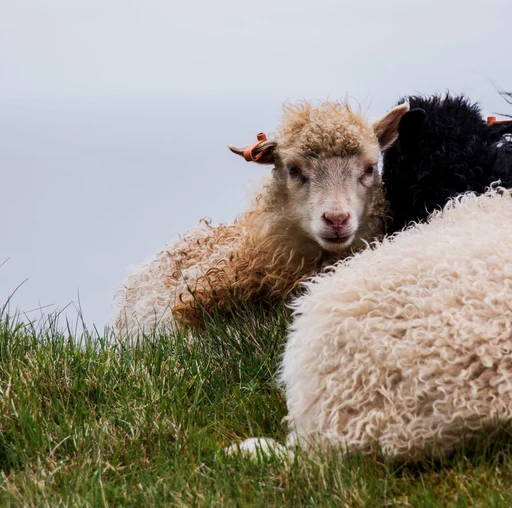
You sit down with Faroese wool that still has the lanolin in it, off sheep that grazed the headland at the south end of the island, and spin your own thread. It takes about three hours, and the first forty minutes belong entirely to the wool.
The best thing about Nólsoy is invisible in daylight. Under the boulder field on the east side is the largest colony of European storm petrels in the world. The bird weighs twenty-six grams, spends the entire day out at sea and only comes home in the dark, which is why the man who has been studying them here for decades takes people out at night and not at lunchtime.


Kalsoy
Nólsoy
Tórshavn
 Klaksvík
Syðradalur
Mikladalur
Trøllanes
Klaksvík
Syðradalur
Mikladalur
Trøllanes
 Kallur


North out of Tórshavn and immediately down under the sea. The Eysturoy tunnel runs eleven kilometers beneath the fjord and has, a hundred and eighty-nine meters below the surface, the only roundabout in the world built inside an undersea tunnel. You are through the roundabout in about a minute, which is barely long enough for anyone to finish explaining it.
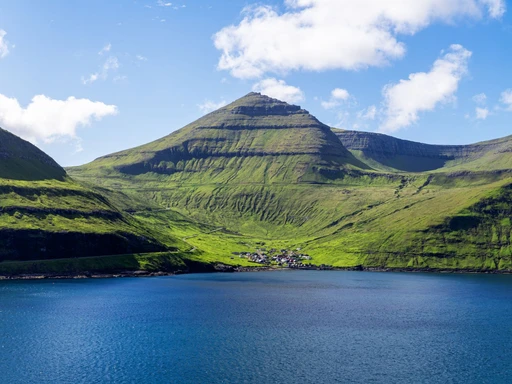
Thirty-six minutes from Tórshavn you reach Klaksvík, 5,190 people, four separate villages that gave up and merged into one town in 1938. Then the ferry, twenty minutes across to Kalsoy, an island so thin and so riddled with road tunnels that the Faroese nickname for it is the recorder, as in the instrument.
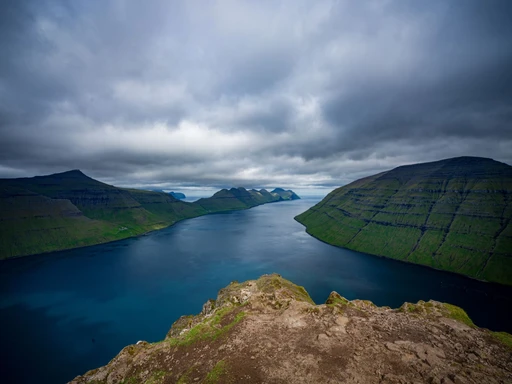
Up the east side through the dark to Mikladalur, where the story goes that a farmer once hid a seal woman's skin so she could not go back to the sea, and it ends badly for everyone involved. Then Trøllanes, population fourteen, and the walk out to Kallur, where the headland narrows to a ridge with a small white lighthouse on the end of it and green cliffs dropping away on both sides. Back to Tórshavn for the farewell dinner, which is at a table in somebody's actual house.

The Good Bakery, Found Too Late
Kallur
Tórshavn


A last slow morning in Tórshavn, which is exactly the sort of place where you find the good bakery on the second-to-last day and take it personally.
Six days ago you did not know these people. Now there is a group chat with a name that will not survive contact with anybody outside it, a camera roll that is ninety percent grass and sea and cannot be edited down by a single frame, and at least one person quietly checking prices for August next year. Your jacket smells of wind and will for two weeks.

Upcoming trips
5 trips
Sørvágur
7 days
TórshavnFri 21 May 2027
T
Tomas
Coordinator
$2,939 $2,879 / person
Available
Sørvágur
7 days
TórshavnFri 11 Jun 2027
E
Elin
Coordinator
$2,939 $2,879 / person
Available
Sat
26
Jun 2027
Sørvágur
7 days
TórshavnFri 2 Jul 2027
T
Tomas
Coordinator
$2,939 $2,879 / person
Available
Sørvágur
7 days
TórshavnFri 23 Jul 2027
E
Elin
Coordinator
$2,939 $2,879 / person
Available
Sørvágur
7 days
TórshavnFri 13 Aug 2027
T
Tomas
Coordinator
$2,939 $2,879 / person
Available
Ask us to run one for your group →
Paying and canceling
Paying
Pay all at once, or in up to 3 equal payments 30 days apart, with no interest and no fee. On a trip that has not confirmed, nothing is charged until it does. The last payment is charged no later than 30 days before the trip starts.
Canceling
You can cancel at any time before the trip starts. What comes back:
- Within 7 days of booking, with the trip more than 60 days away: everything you paid.
- More than 60 days before the trip starts: everything you paid, minus the administrative fee of $160.
- 30 to 60 days before: half the trip price, or everything you paid where that is less.
- Less than 30 days before: nothing.
If unavoidable and extraordinary circumstances at the destination significantly affect the trip, everything you paid comes back, with nothing deducted. The full rules are in the refund policy.
When a trip runs
A trip that needs a minimum number of travelers says so on its date, with the day it is decided. If it has not reached it by then, we cancel it that day, tell you, and return everything you paid.
Reduced mobility
Our trips are not generally suitable for travelers with reduced mobility. Most days involve a good deal of walking, often on uneven ground or stairs, and getting on and off boats, vans and trains, and we cannot promise step-free rooms or transport. If you have a mobility need, write to support@buckettrips.travel before you book and tell us what it is. We will tell you whether this trip works for you, day by day, before you pay anything.